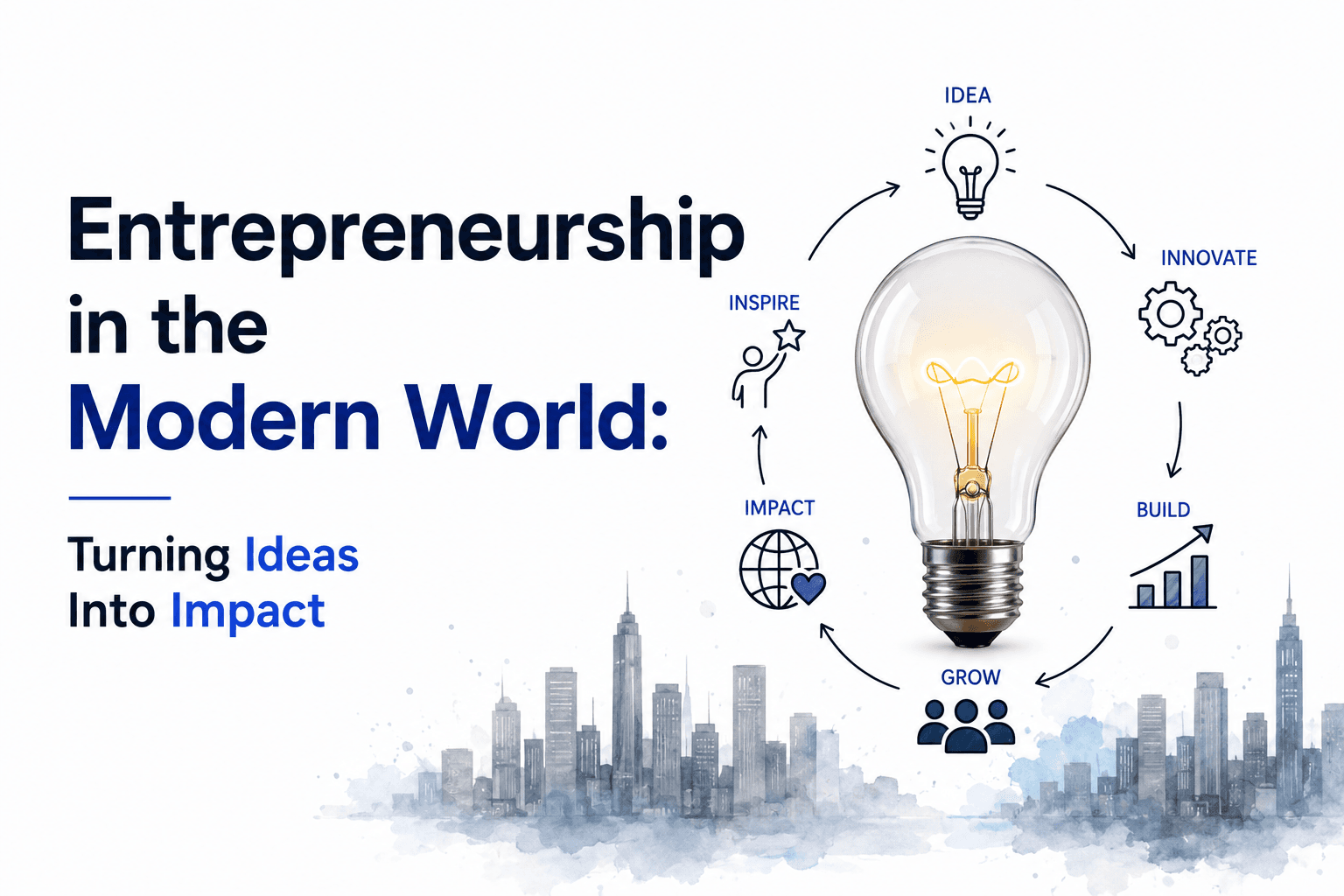
Entrepreneurship in the Modern World: Turning Ideas Into Impact
Discover what modern entrepreneurship means, how entrepreneurs turn ideas into successful ventures, overcome challenges, create innovation, and build businesses that make a lasting impact.
Written by
Anifoards Insights
Published
August 22, 2026
Entrepreneurship has become one of the most powerful forces shaping the modern economy.
From technology startups and small local businesses to global companies, entrepreneurs play an important role in creating new products, solving problems, generating employment, and driving innovation.
But entrepreneurship is often misunderstood.
Many people associate it only with launching a startup, raising investment, or becoming the founder of a successful company.
In reality, entrepreneurship is much broader.
At its core, entrepreneurship is about identifying opportunities and transforming ideas into meaningful solutions.
An entrepreneur sees a problem and asks:
Can this be done better?
They observe gaps in the market.
They recognize changing consumer behavior.
They experiment with new ideas.
And most importantly, they take action.
In today's rapidly changing world, entrepreneurship is no longer limited to a specific age, location, or industry. Technology has made it possible for individuals to build businesses, reach global audiences, and create opportunities in ways that were previously unimaginable.
The modern entrepreneur is not simply building a company.
They are building the future.
What Is Entrepreneurship?
Entrepreneurship is the process of identifying an opportunity, developing an idea, taking calculated risks, and creating value through a business or venture.
An entrepreneur may build:
A startup A small business A technology company A social enterprise A digital platform A creative business A consumer brand
However, entrepreneurship is not defined by the type of company.
It is defined by the mindset behind it.
Entrepreneurs often share certain characteristics:
Curiosity Problem-solving ability Adaptability Resilience Creativity Willingness to learn
They understand that opportunities are often hidden inside problems.
Every Successful Business Begins With a Problem
One of the biggest misconceptions about entrepreneurship is that success begins with a brilliant idea.
Ideas are important.
But many successful businesses begin with something simpler:
A problem.
Entrepreneurs observe challenges experienced by people, businesses, or communities.
They then ask:
Why does this problem exist? Who experiences it? How can it be solved? Can the solution be improved?
For example, inconvenience can create an opportunity.
Long waiting times can create an opportunity.
Poor customer experiences can create an opportunity.
A lack of access can create an opportunity.
The strongest business ideas often do not begin with:
"How can I start a company?"
They begin with:
"How can I solve this problem?"
Entrepreneurship Is About Creating Value
A business can only survive if it creates value.
Value may come in different forms.
A company can create value by:
Saving people time Reducing costs Improving convenience Providing information Creating better experiences Solving important problems
The bigger the problem a business can solve effectively, the greater its potential impact.
This is why entrepreneurs should focus on customers.
A company may have excellent technology, branding, and marketing.
But if people do not find value in the product or service, long-term success becomes difficult.
Successful entrepreneurship requires understanding the relationship between a problem, a solution, and the people who need that solution.
The Modern Entrepreneur Has More Opportunities Than Ever
Technology has changed entrepreneurship.
Starting a business once required significant infrastructure.
Today, an entrepreneur can access:
Cloud computing Artificial intelligence Social media Digital payments E-commerce platforms Online marketing Remote collaboration tools
A person with an idea can build a website, create a digital product, reach customers, and collaborate with people across the world.
This accessibility has lowered many barriers.
However, easier access also means greater competition.
Thousands of businesses can launch online.
The challenge is no longer simply starting.
The challenge is building something meaningful enough to survive.
Ideas Are Easy, Execution Is Difficult
Almost everyone has ideas.
The difference between an idea and a business is execution.
Execution requires:
Research Planning Consistency Testing Learning Improvement
An entrepreneur may have an excellent idea.
But if they cannot build, test, and improve it, the idea remains only an idea.
Successful entrepreneurs understand that the first version of something does not need to be perfect.
It needs to begin.
Many businesses evolve after entering the market.
Customer feedback can reveal problems.
New opportunities can appear.
Strategies can change.
The ability to execute and adapt is often more important than having a perfect plan.
Risk Is Part of Entrepreneurship
Entrepreneurship involves uncertainty.
There is no guarantee that a business will succeed.
A product may fail.
Customers may not respond.
Competition may increase.
Market conditions may change.
This uncertainty is what makes entrepreneurship challenging.
However, successful entrepreneurs do not necessarily take reckless risks.
They learn to take calculated risks.
Before making major decisions, they consider:
Potential opportunities Possible challenges Available resources Worst-case scenarios
Entrepreneurship is not about avoiding failure completely.
It is about learning how to manage uncertainty.
Failure Is Part of the Learning Process
Failure is often discussed negatively.
In entrepreneurship, failure can also provide valuable lessons.
A failed product can reveal what customers do not want.
A poor marketing campaign can provide insights about audience behavior.
A business challenge can improve leadership skills.
The important factor is how an entrepreneur responds.
Some of the most valuable lessons come from mistakes.
However, learning from failure does not mean repeating the same mistakes.
The goal is reflection.
Ask:
What went wrong? What could have been done differently? What did the experience teach me?
Entrepreneurship requires resilience.
The ability to continue learning after setbacks can be a powerful advantage.
Innovation Is the Heart of Entrepreneurship
Innovation does not always mean inventing something completely new.
Sometimes innovation means improving something that already exists.
A business can innovate by:
Making a process faster Improving customer experience Reducing costs Introducing a better business model Using technology creatively
Many successful companies did not invent entirely new industries.
They simply created better experiences.
Innovation begins with curiosity.
Entrepreneurs should constantly ask:
What can be improved?
That question can lead to powerful opportunities.
Understanding the Customer Is Essential
Entrepreneurs sometimes become deeply attached to their ideas.
This can create problems.
A business should not be built only around what the founder personally likes.
It should also understand what customers need.
Customer research can involve:
Conversations Feedback Surveys Market analysis Observing behavior
The goal is to understand real problems.
Listening to customers can reveal opportunities that entrepreneurs may not initially see.
The strongest businesses continuously learn from the people they serve.
Building a Brand, Not Just a Business
In today's competitive environment, products alone may not be enough.
People often connect with brands.
A strong brand communicates:
Identity Values Purpose Trust
Brand building is more than a logo or visual design.
It is the overall perception people have about a business.
Every customer interaction contributes to brand reputation.
The modern entrepreneur must therefore think about:
What does our business stand for?
A clear answer can help create stronger relationships with customers.
Technology Is Changing Entrepreneurship
Technology is giving entrepreneurs access to powerful tools.
Artificial intelligence can assist with productivity.
Social media can help businesses communicate with audiences.
Cloud technology can support remote teams.
Digital platforms can provide access to global markets.
However, technology itself is not the business.
Technology is a tool.
The real advantage comes from how effectively entrepreneurs use it to create value.
The entrepreneurs of the future may not necessarily be technology experts.
But they will need to understand how technology can support their ideas.
Building the Right Team
No successful business is built entirely by one person.
Entrepreneurs eventually need people who can contribute different skills.
A strong team may include individuals with expertise in:
Technology Marketing Operations Finance Product development
Building a team is not simply about hiring talented people.
It is about creating a shared vision.
Great teams often succeed because members understand:
The company's mission Their responsibilities The problems they are trying to solve
Leadership becomes increasingly important as a business grows.
Financial Discipline Matters
An exciting idea can attract attention.
But a business must manage its resources carefully.
Entrepreneurs need to understand basic financial concepts such as:
Revenue Expenses Profitability Cash flow Investment
A company can appear successful while experiencing financial difficulties.
Growth without financial discipline can create problems.
Entrepreneurs should understand where money is coming from and where it is going.
Financial awareness allows founders to make better decisions.
Adaptability Is a Competitive Advantage
Markets change.
Technology evolves.
Customer expectations shift.
A strategy that works today may become less effective tomorrow.
Successful entrepreneurs remain adaptable.
They are willing to:
Change strategies Improve products Learn new skills Explore opportunities
Adaptability does not mean constantly abandoning plans.
It means remaining open to evidence.
If customer behavior changes, businesses must be prepared to respond.
The ability to adapt may become one of the most important entrepreneurial skills of the future.
Entrepreneurship and the Digital Economy
The digital economy has created entirely new opportunities.
Entrepreneurs can build:
Online marketplaces SaaS platforms Digital media brands E-commerce companies AI-powered businesses Creator-led companies
Digital businesses can scale differently from traditional companies.
A digital product may potentially serve customers across multiple locations without requiring physical expansion in every market.
This creates opportunities for rapid growth.
However, digital businesses also face intense competition.
Building technology is becoming easier.
Building trust remains difficult.
Social Entrepreneurship and Purpose-Driven Businesses
Modern entrepreneurship is not focused only on profit.
Many entrepreneurs are building companies designed to create social or environmental impact.
These businesses may focus on:
Education Sustainability Healthcare access Community development
This is often referred to as social entrepreneurship.
The idea is that businesses can create both economic value and positive impact.
The next generation of entrepreneurs may increasingly ask not only:
"How can we build a successful company?"
But also:
"What positive difference can this company create?"
The Importance of Continuous Learning
Entrepreneurship requires continuous learning.
No founder begins with complete knowledge.
Entrepreneurs learn through:
Experience Customers Mentors Books Competitors Failures
The business world changes quickly.
A willingness to learn can prevent entrepreneurs from becoming outdated.
Curiosity is therefore a competitive advantage.
The best entrepreneurs are often not those who believe they know everything.
They are those who continue asking questions.
Entrepreneurship Creates Opportunities for Others
The impact of entrepreneurship extends beyond individual founders.
Businesses create opportunities.
A growing company may create jobs for:
Engineers Designers Marketers Sales professionals Operations teams
Entrepreneurship can also support entire ecosystems.
Suppliers, freelancers, service providers, and other businesses can benefit from economic activity created by growing companies.
This is why entrepreneurship plays an important role in economic development.
Entrepreneurs do not simply create businesses.
They can create ecosystems.
The Future of Entrepreneurship
The future entrepreneur may look very different from the traditional image of a business founder.
They may work remotely.
They may build global teams.
They may use artificial intelligence every day.
They may operate digital-first businesses.
But some principles will remain unchanged.
Successful entrepreneurship will continue to require:
Vision Discipline Curiosity Resilience Adaptability
Technology will change the tools available to entrepreneurs.
But it will not replace the fundamental ability to identify problems and create solutions.
Conclusion
Entrepreneurship is more than starting a company.
It is a way of thinking.
It begins with curiosity.
It grows through action.
And it creates impact through value.
The modern world offers more entrepreneurial opportunities than ever before.
Technology has reduced barriers.
Digital platforms have created global access.
New industries are emerging.
But opportunity alone does not create success.
Entrepreneurs must be willing to learn, adapt, take calculated risks, and continue moving forward.
Every major company began with a beginning.
An idea.
A problem.
A question.
Someone decided that something could be done differently.
That is where entrepreneurship begins.
Entrepreneurship is not about having all the answers. It is about having the courage to start asking better questions—and the determination to turn those answers into action.
Community
Comments
Sign in to join the conversation.
Sign inContinue reading