The Future of Business: How Companies Are Adapting to a Changing World
Discover how companies are preparing for the future through AI, digital transformation, innovation, customer-centric strategies, and adaptability in a rapidly changing business landscape.
Written by
Anifoards Insights
Published
August 26, 2026
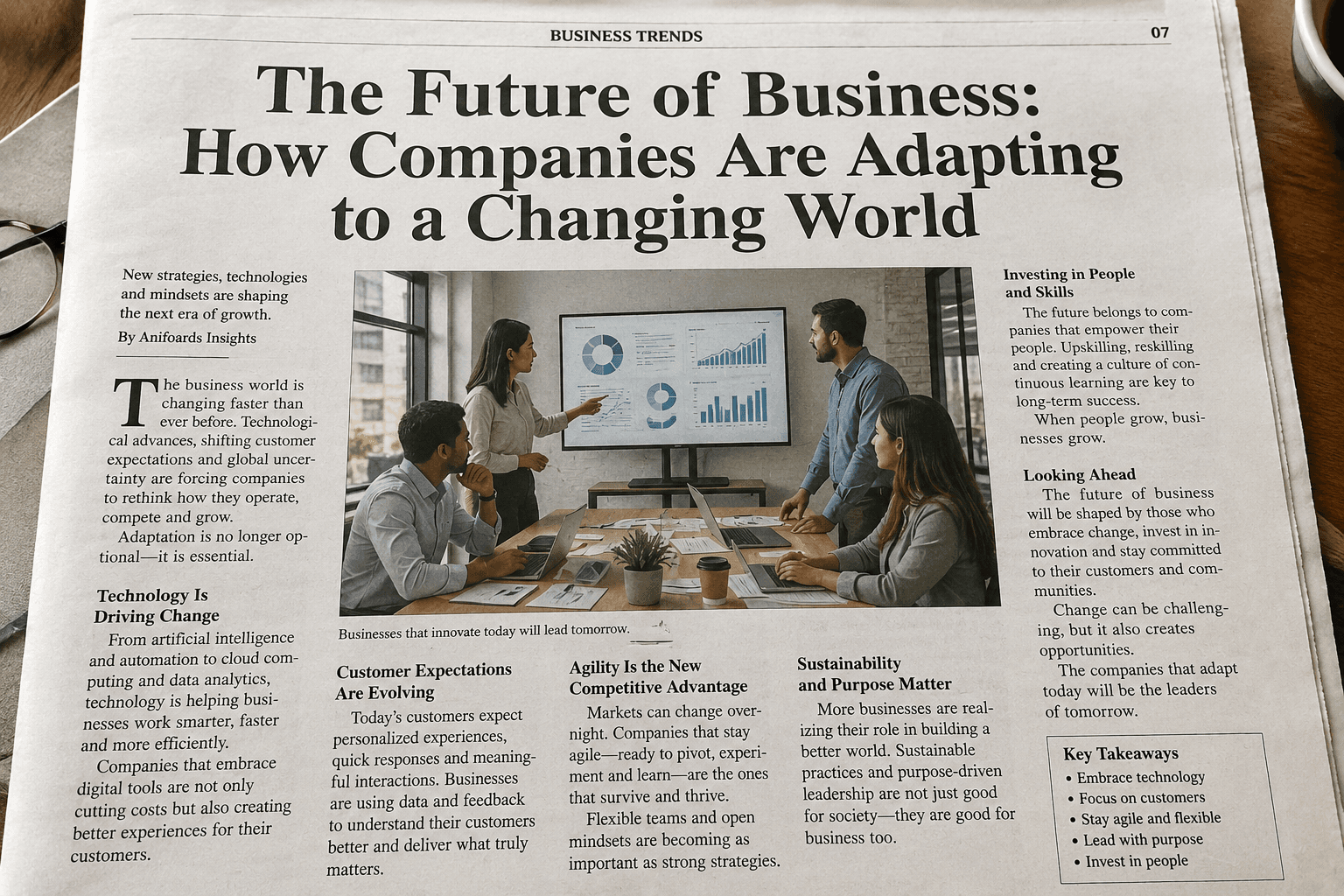
The world of business is changing faster than ever before. Technologies that once seemed futuristic are now becoming part of everyday operations, consumer expectations are constantly evolving, and companies are being forced to rethink how they work, compete, and grow.
For decades, businesses could rely on relatively stable models. A company could establish a product, build a customer base, create a predictable supply chain, and operate in much the same way for years. Today, that environment has changed.
Artificial intelligence, automation, digital platforms, changing workforce expectations, global competition, cybersecurity risks, and rapidly shifting consumer behavior are transforming the business landscape. The companies that succeed in the future may not necessarily be the largest or oldest—they may be the ones that can adapt the fastest.
The future of business is not simply about adopting new technology. It is about building organizations that are flexible, intelligent, customer-focused, and prepared for continuous change. A New Era of Business
Businesses today operate in an environment where change has become constant.
A technological breakthrough can transform an entire industry. A new startup can challenge an established corporation. Consumer preferences can shift within months, and a global event can disrupt supply chains and markets across continents.
This means companies can no longer depend entirely on traditional strategies.
Modern organizations are increasingly focusing on questions such as:
How can we use technology to improve efficiency? How can we better understand our customers? How can we respond faster to market changes? Which tasks should be automated? What skills will employees need in the future? How can we protect our data and digital infrastructure? How can we build a business that remains relevant?
The ability to answer these questions is becoming an important competitive advantage.
Digital Transformation Is No Longer Optional
One of the biggest changes shaping modern businesses is digital transformation.
Digital transformation does not simply mean creating a website or opening social media accounts. It involves integrating digital technology into the core operations of a business.
For example, companies are increasingly using:
Cloud computing Artificial intelligence Data analytics Automation tools Digital payment systems Customer relationship platforms E-commerce solutions Remote collaboration tools
These technologies allow businesses to operate more efficiently and make faster decisions.
A small business today can use cloud software to manage operations, digital marketing to reach customers globally, and AI-powered tools to automate tasks that previously required large teams.
This has significantly changed the competitive landscape.
Technology is reducing many traditional barriers to entry. A startup with a strong idea and effective execution can now reach millions of potential customers without owning massive physical infrastructure.
However, adopting technology alone is not enough. Organizations are increasingly discovering that real transformation requires changes in processes, skills, leadership, and operating models—not simply adding new tools.
Artificial Intelligence Is Reshaping Business Operations
Artificial intelligence has become one of the most significant forces influencing the future of business.
AI is being used across industries for tasks such as:
Customer support Data analysis Content creation Software development Marketing Financial forecasting Supply chain management Fraud detection Human resource operations
The biggest opportunity of AI is its ability to help people process information and perform repetitive tasks more efficiently.
However, the future of AI in business is not simply about replacing humans with machines.
The more important transformation may be the collaboration between humans and intelligent systems.
AI can analyze large amounts of information quickly, but humans remain important for creativity, leadership, ethical judgment, relationship-building, and strategic decision-making.
Companies that are successfully moving forward are increasingly focusing on redesigning workflows around AI rather than merely experimenting with isolated tools. Research in 2026 also suggests that organizations are still working to turn AI adoption into consistent, measurable business value.
The future workplace may therefore be defined by a simple principle:
Technology will handle more routine work, while human skills will become increasingly valuable in areas that require creativity, judgment, empathy, and leadership.
The Customer Is Becoming More Powerful
Another major transformation is the changing relationship between businesses and consumers.
In the past, customers had limited access to information. Today, consumers can compare products, read reviews, watch demonstrations, and research companies within minutes.
This has created a more informed and demanding customer.
Modern consumers expect:
Fast service Personalized experiences Easy digital access Transparent communication Reliable products Quick problem resolution
As a result, companies are increasingly becoming customer-centric.
Businesses can no longer focus only on selling products. They must think about the entire customer experience.
From the first interaction with a brand to post-purchase support, every stage can influence how customers perceive a company.
This is why businesses are investing heavily in customer data, personalization, digital experiences, and community building.
The future belongs to companies that understand one important principle:
Customers do not only buy products—they buy experiences, trust, and value.
Data Is Becoming a Strategic Asset
Data has become one of the most valuable resources available to modern organizations.
Every digital interaction can provide information.
Businesses can analyze:
Customer preferences Buying behavior Market trends Product performance Website activity Operational efficiency
When used responsibly, this information can help companies make better decisions.
For example, instead of guessing which products customers might prefer, businesses can analyze actual purchasing behavior.
Instead of waiting months to identify a market trend, companies can monitor real-time information.
This allows businesses to become more responsive and intelligent.
However, the growing importance of data also creates responsibility.
Companies must consider:
Data privacy Cybersecurity Ethical use of information Transparency Customer trust
As businesses become more digital, protecting information is becoming just as important as collecting it.
The Traditional Workplace Is Changing
The concept of work itself is evolving.
For many years, work was associated with a specific location and a fixed schedule. Employees traveled to offices and performed their roles within traditional organizational structures.
Today, businesses are experimenting with more flexible models.
Depending on the industry and role, companies may operate through:
Remote work Hybrid work Distributed teams Flexible schedules Digital collaboration
Technology has made it possible for teams to collaborate across cities and countries.
At the same time, businesses are recognizing that flexibility alone is not enough. Strong communication, company culture, accountability, and collaboration remain essential.
The future workplace will likely focus less on where people work and more on how effectively they work.
Skills are also becoming increasingly important.
Employees may need to continuously learn new technologies and adapt to changing roles. Research points to a growing need for organizations to redesign jobs and build workforce capabilities alongside technological adoption.
This means lifelong learning may become a fundamental part of professional life.
Agility Is Becoming a Competitive Advantage
One of the most important characteristics of future-ready businesses is agility.
Agility means the ability to respond quickly to change.
Traditional companies often operate through complex systems where decisions move slowly through multiple layers of management.
In a rapidly changing environment, this can become a disadvantage.
Modern businesses are increasingly trying to become:
Faster More flexible More experimental More collaborative More data-driven
Instead of spending years developing a perfect product, some companies launch smaller versions, collect customer feedback, and improve continuously.
This approach allows businesses to learn from the market.
The future may favor organizations that understand that perfection is not always the goal.
Adaptability is.
A company that can identify change early and respond quickly may have a significant advantage over a larger competitor that is slow to act.
Sustainability Is Becoming Part of Business Strategy
Businesses are also facing growing expectations beyond profits.
Customers, investors, employees, and governments are increasingly paying attention to how companies impact society and the environment.
This has encouraged businesses to focus on areas such as:
Sustainable production Renewable energy Ethical supply chains Responsible sourcing Waste reduction Social responsibility
For many organizations, sustainability is gradually becoming part of long-term business strategy.
Companies are realizing that sustainable practices can create operational efficiency, strengthen brand reputation, and prepare organizations for future regulations and changing consumer expectations.
The future business model may therefore focus on balancing three important areas:
Profit. People. Planet.
Cybersecurity Will Become a Business Priority
As companies become increasingly digital, cybersecurity risks are also growing.
Businesses today depend on:
Online systems Cloud platforms Digital payments Customer databases Remote networks AI tools
A single cyberattack can disrupt operations, damage customer trust, and create significant financial consequences.
Cybersecurity is therefore no longer just an IT department responsibility.
It has become a business responsibility.
Future-ready companies will need to build stronger systems for:
Data protection Employee awareness Risk management Cybersecurity infrastructure Crisis response
As artificial intelligence and digital systems become more deeply integrated into business operations, governance and responsible risk management are becoming increasingly important alongside innovation.
The companies that build digital trust may gain a major advantage in the future.
Innovation Will Become a Continuous Process
In the past, innovation was often treated as something that happened occasionally.
A company would develop a new product, launch it, and then focus on maintaining its success.
Today, innovation must be continuous.
Businesses need to constantly ask:
Can this process be improved? Is there a better technology available? Have customer expectations changed? Is a new competitor entering the market? Are we solving the right problem?
Innovation does not always mean creating something completely new.
Sometimes innovation means improving an existing process.
A small improvement in customer experience, delivery speed, product design, or internal operations can create significant value.
The future belongs to organizations that build a culture where employees are encouraged to question, experiment, and improve.
Human Skills Will Remain Essential
Despite the rapid growth of automation and artificial intelligence, human skills will remain essential.
Technology can process information.
But leadership requires judgment.
Algorithms can analyze customer behavior.
But building relationships requires empathy.
Automation can perform repetitive tasks.
But innovation requires imagination.
This means businesses will increasingly value skills such as:
Creativity Critical thinking Communication Leadership Emotional intelligence Problem-solving Adaptability
The future of business will not simply be technological.
It will be a combination of human intelligence and technological intelligence.
The companies that find the right balance between the two may be best positioned for long-term success.
Small Businesses Have a Bigger Opportunity Than Ever
One of the most exciting aspects of the changing business landscape is that opportunities are no longer limited to large corporations.
A small business can now access technologies that were previously available only to major companies.
For example, a small startup can use:
AI tools Cloud infrastructure Digital advertising E-commerce platforms Global payment systems Social media Automation software
This allows entrepreneurs to operate with fewer resources while reaching larger audiences.
The future may therefore create a more competitive environment, but also a more accessible one.
The most valuable asset for a modern business may not be its physical size.
It may be its ability to move quickly, understand customers, and execute ideas effectively.
The Rise of the Adaptive Company
The companies that succeed in the coming years may have one characteristic in common:
They will be highly adaptable.
An adaptive company does not assume that its current success will last forever.
It continuously observes the market.
It listens to customers.
It invests in people.
It experiments with technology.
It learns from mistakes.
And most importantly, it is willing to change.
Business history has repeatedly shown that being successful today does not guarantee success tomorrow.
Industries change.
Technologies evolve.
Consumer behavior shifts.
New competitors emerge.
The challenge for modern companies is not simply to predict the future.
It is to build the ability to respond when the future arrives.
Looking Ahead
The future of business will be shaped by uncertainty.
Artificial intelligence will continue to evolve. New technologies will emerge. Jobs and skills will change. Consumer expectations will become more demanding, and businesses will face increasing pressure to operate responsibly.
But uncertainty also creates opportunity.
Companies that are willing to learn, experiment, and adapt can turn disruption into growth.
The most successful businesses of tomorrow may not necessarily be the ones with the biggest offices, the largest teams, or the longest histories.
They may be the organizations with the strongest ability to evolve.
Technology will play a central role, but technology alone will not determine success.
Strategy, leadership, trust, creativity, and human understanding will remain equally important.
The future of business is not about replacing everything that exists today.
It is about reimagining how businesses create value in a world that never stops changing.
Conclusion
The business world is entering a new era.
Digital transformation, artificial intelligence, changing customer expectations, flexible work models, data-driven decision-making, and sustainability are reshaping how organizations operate.
For companies, the message is clear:
Adaptation is no longer just an advantage—it is becoming a necessity.
The businesses that embrace change while maintaining a clear sense of purpose will be better positioned to navigate the challenges ahead.
The future will belong to companies that can combine innovation with responsibility, technology with human intelligence, and growth with adaptability.
In a rapidly changing world, the greatest competitive advantage may simply be the ability to keep evolving.
Community
Comments
Sign in to join the conversation.
Sign in