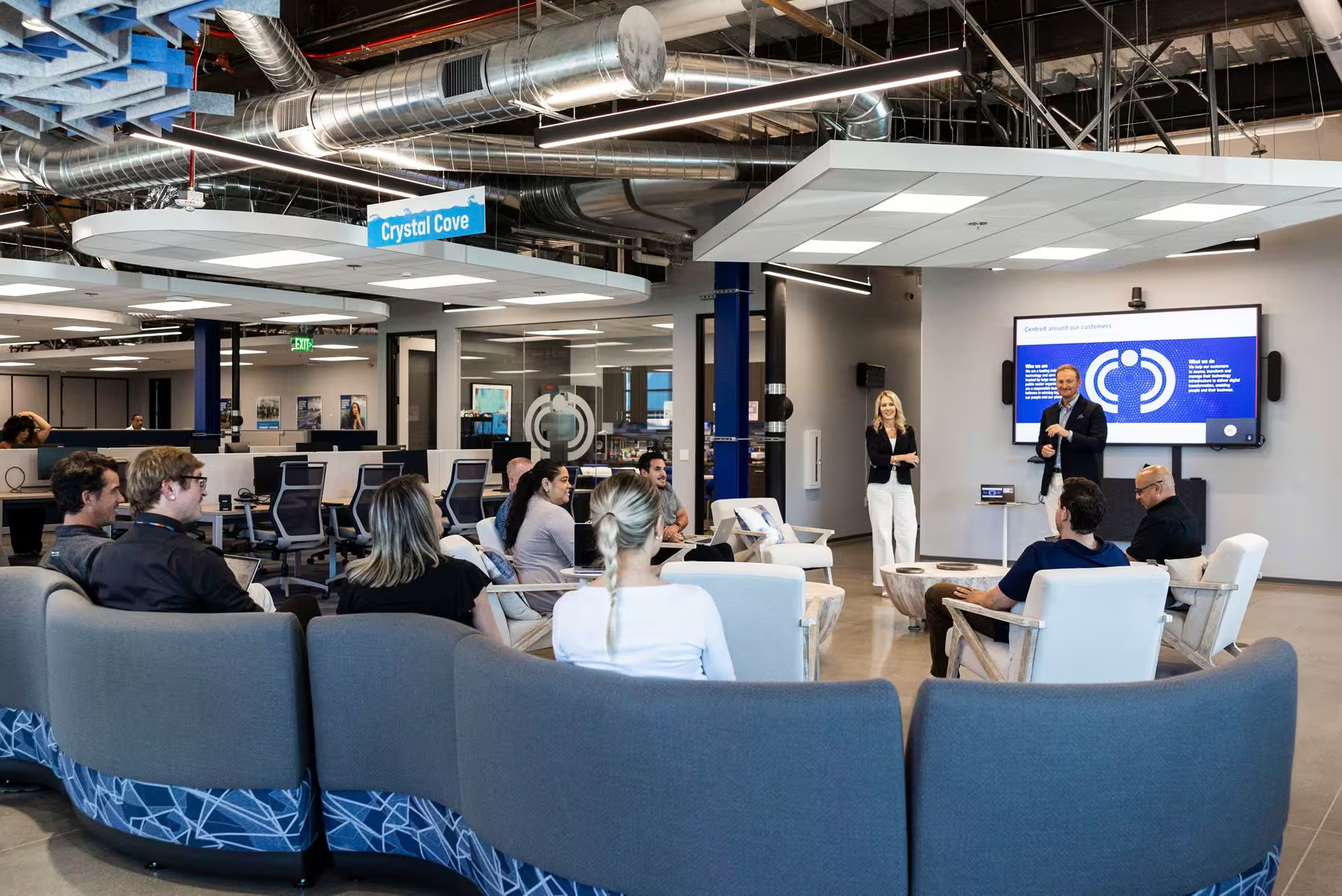
India’s AI Workforce Is Entering a New Era: Productivity Rises as Talent Gaps Grow
India’s AI transformation is reshaping the technology workforce as companies use AI to boost productivity while demand for advanced skills in AI, cloud, cybersecurity and data continues to outpace available talent.
Written by
Anifoards Insights
Published
September 10, 2026

# India’s AI Workforce Is Entering a New Era: Productivity Rises as Talent Gaps Grow # **India, September 10, 2026:** India’s artificial intelligence transformation is moving into a new phase. Companies are no longer treating AI only as an experimental technology; they are increasingly integrating AI into software development, operations, customer services and other core business functions.
The shift is creating a new workplace reality. AI is improving productivity and changing how work is performed, while companies simultaneously face a growing shortage of professionals with advanced AI, cloud, cybersecurity and data skills.
## AI Is Moving From Experimentation to Everyday Business ## India's technology industry is increasingly adopting AI at scale, with companies using AI systems and agents to automate repetitive tasks and help employees manage more complex workloads.
Wipro’s AI Push Shows the Scale of the Change
Wipro says its AI initiatives have generated productivity equivalent to the output of around **20,000 employees**. Rather than simply eliminating those positions, the company says the capacity has been redeployed internally.
Wipro's chief technology officer has described the company's direction as a **human-AI operating model**, in which employees can manage multiple AI agents or move into other roles as the nature of work changes.
More than **100,000 Wipro employees** have received advanced AI-related training and certifications, according to the company.
The Biggest Change May Be in the Workforce
The impact of AI is increasingly being felt not only through automation, but through changing expectations for employees.
AI Is Automating Tasks, Not Necessarily Entire Jobs
New labour-market data indicates that AI is taking over substantial portions of routine technology work.
A CIEL HR report found that demand for **agentic AI engineers in India increased 260% year-on-year in 2026**. Demand for GenAI solutions architects and AI product owners rose 120% each, while demand for LLM engineers and MLOps engineers also recorded strong growth.
The report also found that AI can handle up to **70% of workloads involved in some ticket-resolution and report-generation activities**, while test-case creation can see automation of around 65% of its workload.
This suggests a fundamental shift: routine execution is becoming increasingly automated, while the value of people who can **build, integrate, supervise and govern AI systems** is increasing.
India Is Facing an AI Talent Gap
India has a large technology workforce, but the rapid expansion of AI is creating a different kind of talent challenge.
Companies Need Hybrid Skills
India's more than **2,100 Global Capability Centres (GCCs)** are expanding into increasingly strategic areas such as artificial intelligence, data engineering, cloud computing, cybersecurity and product development.
However, the supply of professionals with the right combination of technical expertise and business understanding remains limited.
A Taggd-CII report found that **52% of GCCs plan to expand their workforce in FY27**, while only **42.6% of graduates** surveyed were considered employable to industry standards. Nearly half of critical roles take more than 60 days to fill.
The Skills Companies Want Are Changing
The fastest-growing areas include: * Agentic AI * Generative AI engineering * AI product management * MLOps * Cloud engineering * Cybersecurity * Data engineering * AI governance
The emerging requirement is increasingly clear: companies want professionals who combine **technical depth, domain knowledge and the ability to work effectively with AI**.
AI Investment Is Rising Rapidly
The workforce transformation is happening alongside a sharp increase in enterprise AI investment.
Indian Companies Are Spending More on AI
ServiceNow's 2026 Enterprise AI Maturity Index found that enterprise AI investment in India increased **119% in one year**, compared with global growth of 110%. AI currently represents about **16.6% of average IT budgets** among Indian organisations and is projected to reach 21.3% by 2027.
The numbers demonstrate that businesses are moving significant resources toward AI.
But investment alone does not guarantee successful adoption.
The Governance Problem
One of India's biggest AI challenges may be developing the systems needed to control and govern increasingly powerful AI tools.
AI Adoption Is Moving Faster Than Governance
Only **22% of Indian enterprises** surveyed by ServiceNow have AI testing, auditing and risk-assessment processes in place. At the same time, 54% are deploying AI agents, while only 11% have moved to autonomous workflows.
This gap matters because AI systems increasingly interact with company data, applications and business decisions.
ServiceNow found that **60% of respondents** identified transparency and potential misinformation as major concerns, while 55% cited regulatory and compliance complexity and 50% pointed to data privacy and security.
Data and Legacy Systems Remain Obstacles
AI also depends heavily on the quality of the infrastructure beneath it.
According to ServiceNow, **74% of Indian organisations** identified data accuracy, access and management as areas requiring improvement, while 56% cited legacy-system integration as a barrier.
That means India's AI race is not simply a race to deploy the latest models.
It is also a race to build the **data, infrastructure and governance foundations** required to use those models reliably.
What This Means for Indian Professionals
The changing AI landscape does not necessarily mean that traditional technology jobs will disappear overnight.
Instead, the composition of those jobs is likely to change.
The AI-Native Professional Is Becoming More Valuable
A software engineer who can effectively work with AI coding agents, an analyst who can build AI-assisted workflows, or a cybersecurity professional who understands AI-driven threats may have an advantage over someone relying exclusively on traditional methods.
The most valuable skill may therefore become the ability to combine **human judgment with machine capability**.
Reskilling Could Become a Competitive Advantage
Companies are increasingly investing in internal training rather than relying exclusively on external hiring.
Wipro's large-scale AI training programme is one example of this strategy, while GCCs are also expanding GenAI training and reskilling initiatives as they struggle to find enough experienced AI professionals.
For employees, this creates an important opportunity: learning how to work with AI could become as important as learning the underlying technical discipline itself.
India’s GCCs Could Become a Major AI Growth Engine
India's Global Capability Centres are also becoming increasingly important to the country's AI ambitions.
GCCs Are Moving Beyond Traditional Back-Office Work
India has more than **2,100 GCCs employing around 2.36 million skilled professionals**, with many centres increasingly involved in research, development, product engineering and AI-driven innovation.
This represents a significant change from the traditional model of India primarily providing lower-cost support services.
If the trend continues, GCCs could become important locations for developing products, intellectual property and AI capabilities for global companies.
But Talent Could Limit Growth
The biggest constraint may be the shortage of professionals who combine technology expertise with business and domain knowledge.
That creates a paradox: **AI is increasing the potential productivity of India's workforce while simultaneously increasing the value of highly skilled human talent.**
The Bigger Picture
India's AI transformation is therefore not simply an automation story.
It is a story about **productivity, skills, investment, governance and the changing nature of work**.
The Next Phase Will Be About Outcomes
Wipro's leadership has argued that companies should move beyond measuring AI through productivity alone and focus on business outcomes such as improved customer experience, new revenue opportunities and stronger business performance.
That could become one of the most important measures of India's AI maturity.
The question is no longer simply:
**“How much work can AI automate?”**
The more important question is:
**“What new value can humans and AI create together?”**
What Comes Next?
India's AI journey is likely to become increasingly focused on three areas:
1. Building AI-Native Talent
Universities, companies and training institutions will need to develop professionals capable of working alongside increasingly capable AI systems.
2. Scaling Responsible AI
Businesses will need stronger governance, security, auditing and data infrastructure as AI moves into more consequential workflows.
3. Turning Productivity Into Growth
The ultimate test will be whether AI-driven productivity translates into better products, new businesses, higher-value services and stronger economic growth.
Final Insight
India has already demonstrated that it can adopt digital technologies at enormous scale.
The next challenge is more complicated.
**India must turn AI adoption into sustainable productivity while ensuring that its workforce, infrastructure and governance systems evolve at the same speed.**
The evidence emerging in 2026 suggests that the transformation has already begun. Companies are training employees, AI is absorbing routine workloads, demand for advanced skills is accelerating and enterprise investment is rising.
But the biggest opportunity may lie ahead.
**India's AI advantage will ultimately depend not on replacing people with machines, but on building a workforce capable of making the machines dramatically more useful.**
Community
Comments
Sign in to join the conversation.
Sign inContinue reading