Financial Literacy: Why Understanding Money Is More Important Than Ever
Financial Literacy: Why Understanding Money Is More Important Than Ever Meta Description: Discover why financial literacy is essential in today's world and learn how understanding money, budgeting, saving, investing, debt, and financial planning can help build a secure future.
Written by
Anifoards Insights
Published
August 22, 2026
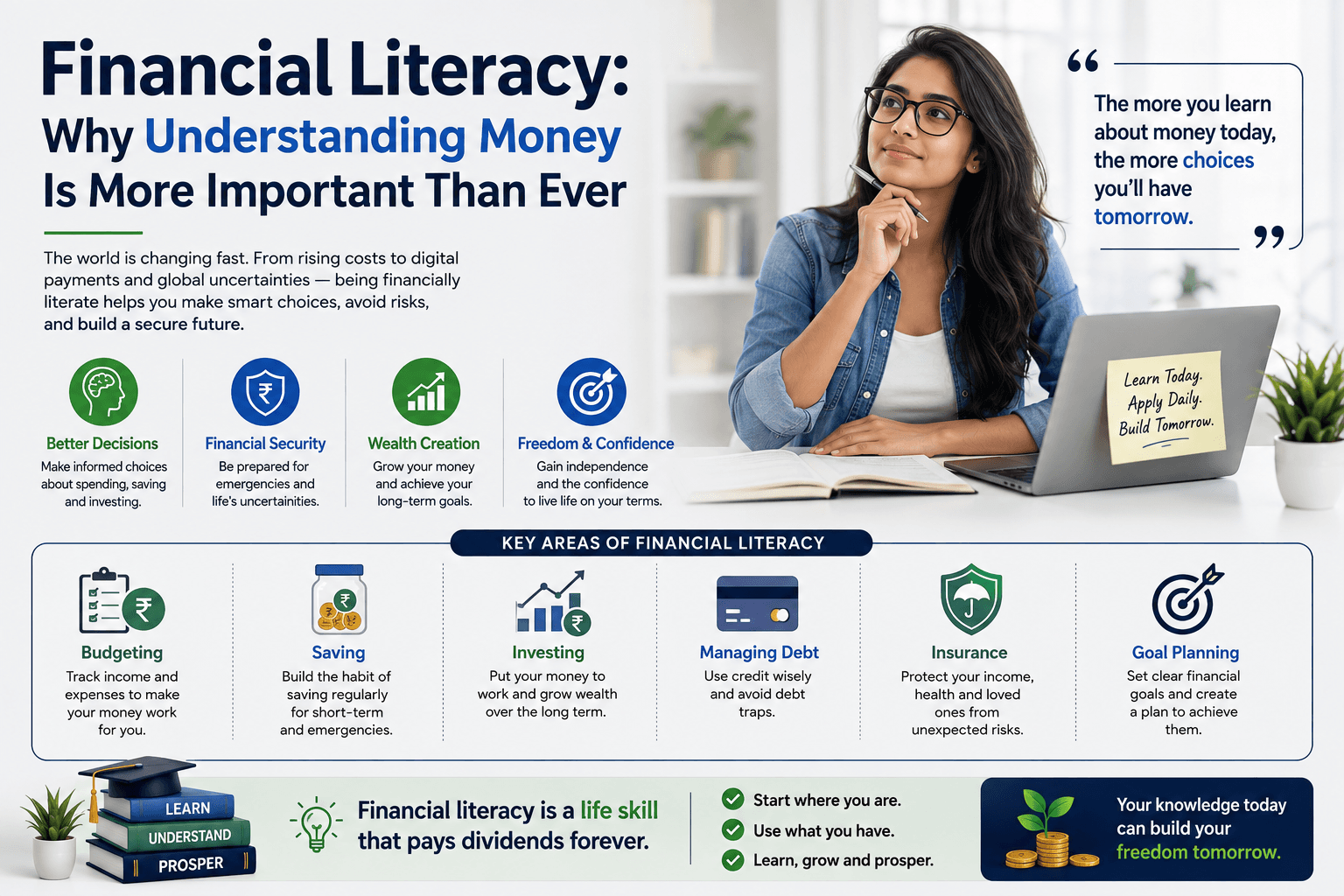
Money is one of the most important parts of modern life, yet financial education is something many people never formally receive.
People spend years learning academic subjects and developing professional skills, but many enter adulthood without a clear understanding of budgeting, saving, investing, debt, taxes, insurance, or long-term financial planning.
As a result, earning money and managing money often become two completely different challenges.
In today's rapidly changing economic environment, financial literacy has become more important than ever. Rising living costs, easy access to credit, digital payments, investment platforms, and an increasing number of financial products have made financial decisions more complex.
Understanding how money works is no longer a skill reserved for financial professionals.
It is becoming an essential life skill.
Financial literacy helps individuals make informed decisions, avoid unnecessary financial risks, plan for the future, and build greater financial confidence.
What Is Financial Literacy?
Financial literacy refers to the ability to understand and effectively manage personal finances.
It includes knowledge about important financial concepts such as:
Income Expenses Budgeting Saving Investing Debt Interest Insurance Taxes Financial planning
However, financial literacy is not about becoming an expert in every financial product.
It is about understanding enough to make responsible decisions.
A financially literate person understands the difference between spending and investing.
They recognize the importance of saving.
They understand that borrowing money has costs.
They think about long-term financial goals rather than only immediate needs.
Most importantly, they develop a healthier relationship with money.
Earning Money Is Not the Same as Managing Money
One of the biggest misconceptions about personal finance is that people with high incomes automatically have strong financial security.
Income is important, but income alone does not determine financial stability.
A person earning a significant amount of money can still face financial difficulties if their expenses continuously exceed their income.
At the same time, someone with a moderate income can gradually build financial stability through disciplined financial habits.
The difference often comes down to financial management.
A simple financial principle is:
It is not only about how much money you earn. It is also about how effectively you manage the money you have.
Understanding where money goes is the first step toward financial control.
The Importance of Budgeting
A budget is one of the most basic and powerful financial tools.
Budgeting simply means creating a plan for how income will be used.
It helps individuals understand:
How much they earn How much they spend Where their money goes Which expenses are necessary Where unnecessary spending can be reduced
Without a budget, people often make financial decisions based on assumptions.
They may believe they are saving money while unknowingly spending most of their income.
A budget creates awareness.
It does not mean eliminating everything enjoyable from life.
Instead, it means making intentional decisions.
A healthy budget may include categories such as:
Essential expenses Savings Investments Personal spending Emergency funds
The exact structure will vary depending on individual circumstances.
The important principle is knowing where your money is going.
Saving Creates Financial Security
Saving is one of the foundations of personal finance.
Unexpected situations can occur at any time.
A job loss, emergency expense, family responsibility, or unexpected repair can create financial pressure.
Without savings, individuals may be forced to borrow money.
This is why building an emergency fund is often considered an important financial habit.
Savings provide flexibility.
They give people time to make better decisions instead of reacting immediately to financial pressure.
However, saving should not always be confused with long-term wealth creation.
Keeping all money unused may protect short-term financial security, but long-term financial goals may require a broader strategy.
This is where understanding the difference between saving and investing becomes important.
Saving vs Investing: Understanding the Difference
Saving and investing are both important, but they serve different purposes.
Saving
Saving generally focuses on preserving money for:
Emergencies Short-term goals Planned expenses
Savings usually prioritize accessibility and stability.
Investing
Investing generally focuses on long-term financial growth.
People invest with the expectation that their money may generate returns over time.
Investment decisions can involve different levels of risk.
The key lesson is that financial planning should consider time horizons.
Money needed soon may require a different approach from money intended for long-term goals.
Financial literacy helps people understand that there is no single strategy suitable for every situation.
Goals, timelines, responsibilities, and risk tolerance all matter.
Understanding the Power of Compounding
One of the most important concepts in finance is compounding.
Compounding refers to the process where returns generated on money can themselves begin generating additional returns over time.
The longer the time period, the more significant the potential effect can become.
This is why time is often considered one of the most valuable assets in long-term financial planning.
Starting early does not necessarily require starting with large amounts.
Consistency can also play an important role.
A person who develops disciplined financial habits early may have more opportunities to benefit from long-term growth than someone who delays financial planning for many years.
The principle is simple:
Small financial decisions made consistently over time can create significant long-term impact.
Debt Is a Tool, Not Free Money
Access to credit has become easier than ever.
Credit cards, personal loans, digital lending platforms, and other financial products allow people to access money quickly.
However, easy access can sometimes create financial problems.
Debt is not always negative.
Businesses use loans to expand.
Individuals may use loans for education, homes, or other important purposes.
The problem occurs when borrowing happens without understanding the cost.
Before taking on debt, people should understand:
Interest rates Repayment terms Monthly obligations Total repayment amount Potential financial risks
Borrowing should be a financial decision—not an emotional reaction.
A financially informed individual understands that borrowed money eventually needs to be repaid, often with additional costs.
Digital Payments Have Changed Spending Habits
The growth of digital payments has made transactions faster and more convenient.
People can make purchases instantly through:
Mobile banking Digital wallets Cards Online payment platforms QR code payments
This convenience has many benefits.
However, it can also make spending feel less visible.
When people physically hand over cash, they often have a stronger awareness of the transaction.
Digital payments can make multiple small purchases feel insignificant.
Over time, these small expenses can become substantial.
Financial literacy therefore requires awareness of digital spending.
Convenience should not remove financial discipline.
Tracking expenses has become increasingly important in a cashless economy.
Financial Goals Give Money a Purpose
Money management becomes easier when people have clear goals.
Without goals, saving can feel difficult.
A person may ask:
Why should I save money?
The answer depends on individual priorities.
Financial goals may include:
Buying a home Higher education Starting a business Travel Retirement Building an emergency fund
Goals give financial decisions direction.
Short-term goals may require different strategies from long-term goals.
For example, money required within a few months should generally be considered differently from money intended for a future several years away.
Financial literacy helps individuals connect everyday decisions with larger life objectives.
Inflation Changes the Value of Money
One important financial concept is inflation.
Over time, the cost of goods and services can increase.
This means the purchasing power of money may change.
A certain amount of money that can purchase several products today may not have the same purchasing power in the future.
Understanding inflation is important because it affects long-term financial planning.
People must think beyond the amount of money they have today.
They should also consider what that money may be able to purchase in the future.
This is one reason financial planning often focuses on long-term growth and not simply storing money.
Investing Requires Knowledge, Not Just Excitement
The internet has made investing more accessible.
People can access financial news, investment platforms, and market information more easily than previous generations.
However, access to information does not automatically create understanding.
Social media can also create excitement around specific assets or investment trends.
Making financial decisions based entirely on hype can be risky.
Financial literacy encourages people to ask important questions:
Do I understand this investment? What are the risks? What is my time horizon? Why am I investing? How does this fit into my financial goals?
The goal should not be to follow every trend.
The goal should be to make informed decisions.
Financial Planning Reduces Uncertainty
Life is unpredictable.
Financial planning cannot eliminate uncertainty, but it can improve preparedness.
A financial plan may consider:
Emergency savings Insurance Long-term goals Major future expenses Retirement planning Family responsibilities
Planning allows people to think ahead.
Instead of reacting to every financial challenge, individuals can gradually prepare for potential situations.
Financial security does not necessarily mean having unlimited money.
It can also mean having a plan.
Financial Literacy and Young Professionals
Financial literacy is especially important for young professionals.
Receiving a first salary is an important milestone.
However, it can also introduce new financial responsibilities.
Many young professionals must learn how to manage:
Monthly expenses Savings Taxes Insurance Investments Loans
The financial habits developed early in life can have long-term consequences.
A person who learns to budget and save early may develop greater financial discipline over time.
This does not mean young people should avoid enjoying life or spending money.
The goal is balance.
Financial responsibility should support life—not prevent people from living it.
The Role of Financial Education
Financial education should become more accessible.
Many people learn about money only after making expensive mistakes.
Basic financial concepts could help individuals make better decisions before facing major financial responsibilities.
Financial education can help people understand:
How interest works Why debt can become expensive How budgeting helps Why saving matters How risk affects investments
The goal should not be to turn everyone into financial experts.
The goal should be to ensure that people have enough knowledge to ask better questions and make more informed choices.
Financial Literacy Can Create Confidence
One of the biggest benefits of financial literacy is confidence.
Money can create anxiety when people do not understand their financial situation.
Uncertainty creates stress.
Knowledge can help reduce some of that uncertainty.
When individuals understand their income, expenses, goals, and responsibilities, they can make decisions with greater clarity.
Financial literacy gives people a sense of control.
It encourages them to move from asking:
"Where did all my money go?"
To asking:
"How can I make my money work better for my goals?"
That shift in thinking can be powerful.
Building Better Financial Habits
Financial literacy is not developed overnight.
It is a continuous process.
Some useful habits include:
1. Track Your Expenses
Know where your money is being spent.
2. Create a Budget
Plan your income and expenses.
3. Build an Emergency Fund
Prepare for unexpected situations.
4. Avoid Unnecessary Debt
Understand borrowing before taking financial obligations.
5. Set Financial Goals
Give your money a clear purpose.
6. Learn Continuously
Financial products and markets evolve.
7. Think Long-Term
Avoid making every financial decision based only on immediate needs.
Small habits can gradually create stronger financial discipline.
Financial Literacy in a Changing World
The financial world is becoming increasingly complex.
New technologies are changing banking.
Digital assets are creating new conversations.
Investment platforms are becoming more accessible.
Artificial intelligence is beginning to influence financial services.
As financial options increase, the need for financial understanding also increases.
The future will offer more opportunities—but also more choices.
Making good decisions will require knowledge.
Financial literacy may therefore become one of the most important skills for navigating modern life.
Conclusion
Understanding money is not about becoming obsessed with wealth.
It is about creating freedom, security, and opportunities.
Financial literacy helps people understand how their decisions today can influence their future.
It teaches the importance of budgeting, saving, responsible borrowing, long-term planning, and informed investing.
In a world where financial decisions are becoming increasingly complex, knowledge is one of the most valuable assets a person can have.
You do not need to understand everything immediately.
Financial literacy begins with simple questions.
Where does my money go?
What are my financial goals?
Am I prepared for unexpected expenses?
How can I make better decisions?
The answers may change throughout life.
But developing the ability to ask these questions is the beginning of financial awareness.
Financial freedom does not begin when you earn more money. It begins when you understand how to manage the money you already have.
Community
Comments
Sign in to join the conversation.
Sign inContinue reading