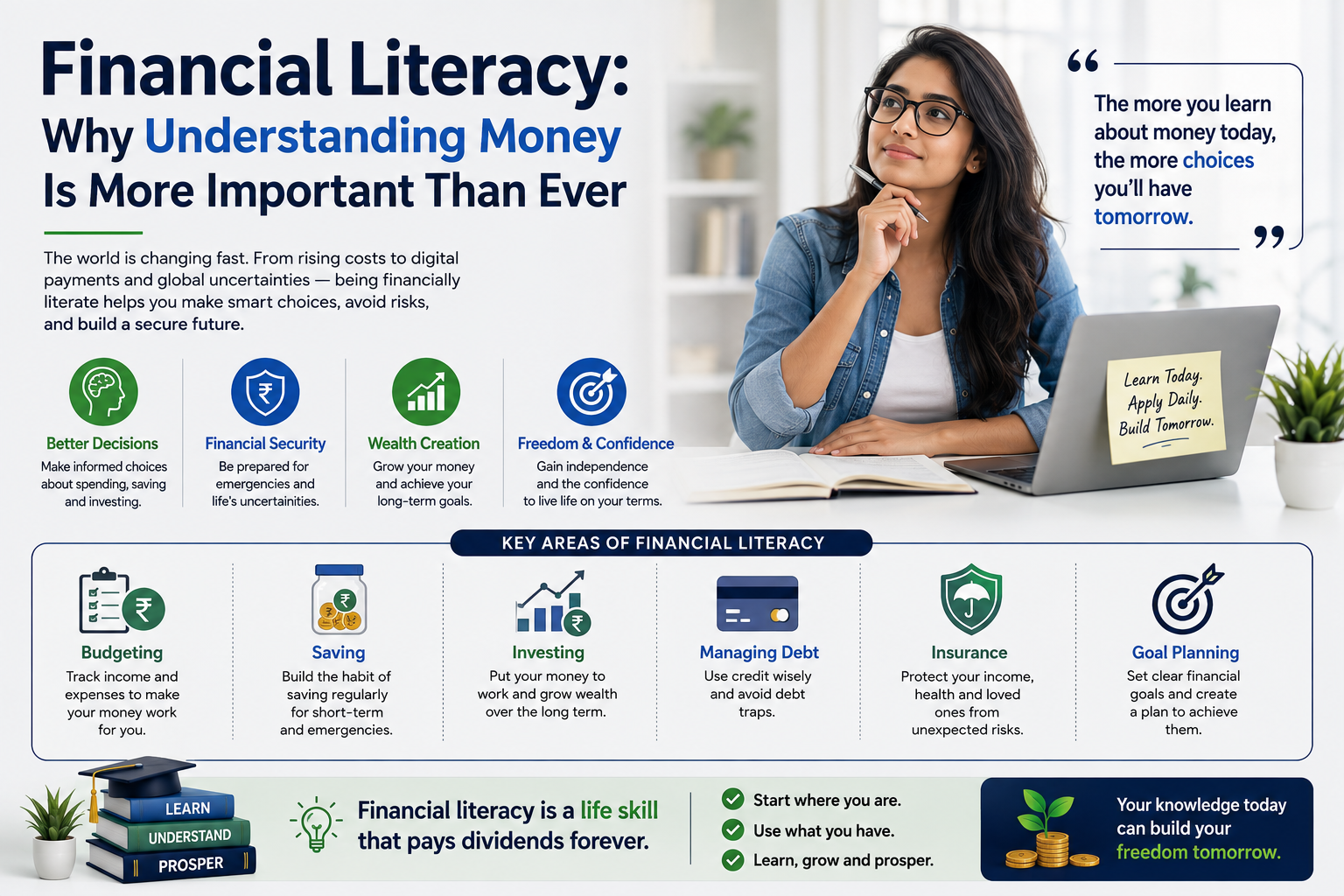
Understanding the Difference Between Saving, Investing and Wealth Creation
Learn the difference between saving, investing, and wealth creation. Understand how each plays a role in financial planning, long-term growth, financial security, and building a stronger financial future.
Written by
Anifoards Insights
Published
August 29, 2026

When people talk about managing money, three words are often used interchangeably: saving, investing, and wealth creation.
Although these concepts are closely connected, they are not the same.
Saving money can provide financial security. Investing can potentially help money grow over time. Wealth creation is the broader, long-term process of building financial strength through income, assets, disciplined financial decisions, and sustainable growth.
Understanding the difference between these concepts is important because each serves a different purpose.
A person who only saves may protect their money but may not necessarily focus on long-term growth. Someone who invests without financial discipline may take unnecessary risks. And wealth creation requires much more than simply earning a high income.
In an increasingly complex financial world, understanding how saving, investing, and wealth creation work together can help individuals make more informed financial decisions.
What Is Saving?
Saving is the process of setting aside a portion of your income instead of spending it immediately.
The primary purpose of saving is usually financial security and accessibility.
People save money for different reasons, including:
Emergency expenses Short-term goals Major purchases Travel Education Future planned expenses
Saving provides a financial cushion.
For example, imagine an unexpected expense occurs. A person with savings may be able to manage the situation without immediately borrowing money.
This is one of the biggest advantages of saving.
It creates flexibility.
Why Saving Is Important
Saving is often the foundation of a healthy financial life.
Before thinking about complex financial strategies, individuals should understand the importance of keeping some money aside.
Savings can help reduce financial stress.
They can provide protection during unexpected situations.
They can also help people achieve short-term goals without relying entirely on debt.
A simple habit of regularly setting aside a portion of income can gradually create financial discipline.
However, saving everything without considering long-term financial goals may not always be enough.
This is where investing becomes an important concept.
What Is Investing?
Investing generally involves allocating money toward assets or opportunities with the expectation of generating potential returns over time.
Unlike saving, investing usually focuses more on long-term growth.
Investments can take different forms and involve different levels of risk.
The fundamental idea is that instead of keeping all money unused, a person allocates a portion toward opportunities that may increase in value or generate income over time.
However, investing involves uncertainty.
Values can increase or decrease.
Returns are not guaranteed.
This is why understanding risk is an important part of financial education.
Before investing, individuals should consider:
Their financial goals Investment timeline Risk tolerance Financial responsibilities Understanding of the investment
Investing should not be confused with gambling or blindly following trends.
A responsible approach requires knowledge and patience.
Saving vs Investing: The Key Difference
The main difference between saving and investing is their purpose.
Saving Investing Focuses on financial security Focuses on potential growth Usually suitable for shorter-term needs Often associated with longer-term goals Prioritizes accessibility May involve longer holding periods Generally focuses on preserving money Involves varying levels of risk Helps prepare for emergencies Helps pursue financial growth
Both are important.
Saving and investing should not necessarily be viewed as competing strategies.
They can serve different roles within a financial plan.
Why Keeping All Your Money Idle May Not Be Enough
Many people believe that simply accumulating money is the same as building wealth.
However, there is an important factor to consider:
Time changes the purchasing power of money.
As the cost of goods and services changes over time, the value of a fixed amount of money can also be affected.
This is why long-term financial planning often considers growth alongside security.
The challenge is finding the right balance.
Individuals may need accessible money for emergencies while also thinking about longer-term financial objectives.
Financial planning is therefore not simply about choosing between saving and investing.
It is about understanding the role of each.
What Is Wealth Creation?
Wealth creation is a broader concept.
It refers to the long-term process of building financial strength.
Wealth creation can involve:
Increasing income Saving consistently Investing responsibly Building assets Creating businesses Developing valuable skills Managing expenses Reducing unnecessary debt
Wealth is not simply about having a large amount of cash.
It can involve building assets, opportunities, and financial stability over time.
A person may earn a high income but struggle financially because of poor financial habits.
Another person may gradually build financial strength through disciplined decisions.
This is why wealth creation is often a long-term process rather than a single event.
Wealth Creation Begins With Financial Discipline
Before creating significant wealth, people often need to develop financial discipline.
This includes understanding:
How much they earn How much they spend How much they save What financial goals they have
Financial discipline creates a foundation.
Without it, increasing income alone may not improve financial stability.
Consider two individuals.
Both receive an increase in income.
The first increases their lifestyle expenses immediately.
The second carefully allocates part of the additional income toward future goals.
Over time, their financial situations may become very different.
The amount of money someone earns matters.
But how they manage increasing income can also influence long-term outcomes.
Income Is the Starting Point, Not the Final Goal
Income plays an important role in financial growth.
However, wealth creation requires looking beyond income.
There are generally two important questions:
How much money do you earn? What do you do with the money you earn?
Increasing income can create more opportunities.
This is why investing in professional skills can be valuable.
New knowledge and expertise may improve earning potential.
Examples include skills in:
Technology Business Sales Marketing Communication Leadership Design
Personal development can therefore become part of wealth creation.
One of the most valuable assets an individual may have is the ability to create value.
Assets and Liabilities: Understanding the Difference
A basic concept in wealth creation is understanding the difference between assets and liabilities.
In simple terms:
Assets are things that may hold value or potentially contribute to financial growth.
Liabilities are financial obligations that require payments or create ongoing costs.
Understanding this distinction can help individuals think more strategically about financial decisions.
Before making a major financial commitment, it can be useful to ask:
Will this decision strengthen my long-term financial position or create unnecessary financial pressure?
Not every purchase needs to create financial returns.
People should enjoy life and spend money responsibly.
The goal is not to eliminate spending.
The goal is to create awareness.
The Role of Compounding in Long-Term Wealth Creation
One of the most powerful concepts associated with long-term financial growth is compounding.
Compounding refers to the potential for returns to generate additional returns over time.
The longer the period, the greater the potential impact can become.
This is why consistency and patience are often important in long-term financial planning.
Small financial actions repeated over many years can potentially have a significant impact.
However, compounding should not be viewed as a shortcut to instant wealth.
Its potential strength is connected to time.
The earlier people develop disciplined financial habits, the more time they may have to pursue long-term goals.
Wealth Creation Requires Multiple Sources of Strength
Traditional thinking often focused on a single source of income.
A person worked for an organization and received a salary.
Today, the economic landscape is changing.
Some individuals explore additional sources of income through:
Businesses Freelancing Consulting Digital products Creative work Professional services
The idea is not that everyone needs multiple income sources immediately.
Instead, it highlights the importance of adaptability.
Financial security can become stronger when an individual continues developing skills and opportunities.
However, building multiple income streams should be approached carefully.
Quality and sustainability are more important than simply chasing every opportunity.
The Relationship Between Risk and Reward
Investing and wealth creation often involve risk.
Different financial opportunities involve different levels of uncertainty.
Generally, higher potential returns may also involve higher levels of risk.
This makes risk management important.
Financial literacy encourages people to understand:
What they are investing in What could go wrong How much risk they can realistically handle Whether an opportunity aligns with their goals
The goal is not to avoid every risk.
It is to avoid unnecessary and poorly understood risks.
A good financial decision is not automatically the one with the highest possible return.
It is the decision that fits an individual's broader financial situation and objectives.
Avoiding the Get-Rich-Quick Mindset
One of the biggest obstacles to long-term wealth creation is impatience.
The internet is filled with promises of quick financial success.
People may see headlines about overnight millionaires or dramatic investment returns.
However, sustainable financial growth usually takes time.
Quick-profit thinking can encourage:
Emotional decisions Excessive risk-taking Poor financial planning Unrealistic expectations
Long-term wealth creation is often less exciting than people imagine.
It may involve:
Consistent saving Continuous learning Responsible financial decisions Patience Long-term planning
The process may be slow.
But consistency can be more sustainable than chasing shortcuts.
A Balanced Financial Approach
A healthy financial strategy often requires balance.
Saving provides security.
Investing may support long-term growth.
Wealth creation provides the broader vision.
A simplified financial journey might look like this:
Step 1: Create Financial Awareness
Understand income and expenses.
Step 2: Build Saving Habits
Develop consistency and financial discipline.
Step 3: Prepare for Emergencies
Create a financial safety cushion.
Step 4: Define Long-Term Goals
Understand what you are working toward.
Step 5: Learn About Investment
Develop knowledge before making decisions.
Step 6: Focus on Long-Term Value
Think beyond immediate financial results.
Step 7: Continue Building Skills
Increase your ability to create opportunities.
This approach is not a universal formula.
Every individual's circumstances are different.
But it demonstrates how saving, investing, and wealth creation can be connected.
Wealth Is More Than Money
An interesting aspect of wealth creation is that wealth can extend beyond financial assets.
Knowledge is valuable.
Skills are valuable.
Professional relationships can be valuable.
Good health and time can also influence a person's ability to build opportunities.
A person with strong skills may be better positioned to adapt to changing industries.
A professional network may create new opportunities.
Knowledge can improve decision-making.
This broader perspective helps explain why wealth creation is a long-term journey.
It involves building resources—not simply accumulating money.
Financial Planning Should Evolve With Life
Financial priorities change.
A student may focus on education.
A young professional may focus on building savings.
An entrepreneur may focus on business growth.
A family may focus on financial security.
Later in life, priorities may shift again.
This is why financial planning should not remain static.
People should regularly review their:
Goals Income Expenses Responsibilities Risk tolerance
A financial strategy that worked five years ago may need adjustments today.
Adaptability is an important part of financial intelligence.
Common Mistakes to Avoid
Understanding financial concepts can also help people avoid common mistakes.
1. Saving Without a Clear Goal
Saving becomes easier when money has a purpose.
2. Investing Without Understanding Risk
Never assume high returns are guaranteed.
3. Ignoring Emergency Planning
Unexpected situations can affect long-term plans.
4. Increasing Expenses With Every Income Increase
Financial progress should grow alongside lifestyle improvements.
5. Comparing Financial Journeys
Everyone has different circumstances and responsibilities.
6. Chasing Quick Wealth
Sustainable financial growth generally requires patience.
The Future of Personal Wealth Creation
Technology is changing how people interact with money.
Financial services are becoming increasingly digital.
Information is more accessible.
New business models are creating new opportunities.
Artificial intelligence may also influence financial planning and decision-making.
However, technology cannot replace fundamental financial principles.
Regardless of how financial systems evolve, some principles remain relevant:
Spend thoughtfully Save consistently Understand risk Plan for the future Continue learning
The tools may change.
The importance of financial discipline will remain.
Conclusion
Saving, investing, and wealth creation are connected, but they serve different purposes.
Saving provides security.
Investing focuses on potential growth.
Wealth creation is the long-term process of building financial strength.
Understanding these differences can help individuals make more informed financial decisions.
There is no need to choose one and ignore the others.
A strong financial foundation often involves balance.
Start by understanding your financial situation.
Develop consistent habits.
Build security.
Learn continuously.
And think beyond short-term results.
Wealth creation is not simply about earning more money.
It is about making thoughtful decisions over time.
Saving protects your present. Investing may support your future. Wealth creation is the journey of building both financial security and long-term opportunity.
Community
Comments
Sign in to join the conversation.
Sign inContinue reading